Please remember to check the ‘Catholic Life and Chaplaincy Notices’ tab weekly! – Flame 2027 – Register your interest with Lucy or via your Form Tutor ASAP.
Helpful resources to support the planning and delivery of prayer and liturgy can also be found on our diocesan Chaplaincy website here.
Part 1 – Watch
Part 2 – Listen
Part 3 – Do
Catholic Life and Chaplaincy Notices
Useful Resources
| The Word of the Week is: | We are in: | The liturgical colour is: |
| Rosary | Week 27 in Ordinary Time, Year A | Green (although blue is sometimes used for celebrations in honour of the Blessed Virgin Mary – such as when the Word of the Week is Rosary) |
You are invited to begin by making the Sign of the Cross.
Response: In the name of the Father and of the Son and of the Holy Spirit. Amen.
In the Catholic tradition, the month of October is dedicated to the Holy Rosary. The Rosary is a prayer that we can all use to meditate on the life of Jesus Christ. It is a powerful tool for prayer and spiritual growth through the intercession of Mary our mother. It’s worth noting here that Catholics do not pray to Mary, but we do honour her highly since she was chosen by God to be the mother of his son. Therefore, we do ask Mary to intercede for us – this means we ask Mary to pray with us and for us.
The Rosary can help us to grow in our faith, to deepen our relationship with God, and to find peace and comfort in difficult times. The Rosary includes traditional prayers such as the Our Father, Hail Mary and Glory Be. Did you know that if you were to pray the full Rosary you would pray the Hail Mary over fifty times? Depending on what day of the week you pray the Rosary, you might focus on specific mysteries which include various events from the life of Jesus.
On Sunday 27th September 2026, Pope Leo led over 500,000 people in the prayer of the holy Rosary in Lourdes during his apostolic visit to France. You might have heard of Lourdes before in your RE lessons at school. In July this year, eight of our current Year 13 students went on pilgrimage to Lourdes with Mrs Levey, Mrs McNulty and many other people from across the Diocese of Nottingham.
Today, you are invited to watch this video of Pope Leo visiting Lourdes. Look at how many people are there, and how they are all come together as one community to pray the Rosary together as they process in torchlight through Lourdes. Afterwards, watch Pope Leo call the faithful to pray the Rosary for world peace during the month of October this year.
Hail, Mary, full of grace, the Lord is with thee. Blessed art thou amongst women and blessed is the fruit of thy womb, Jesus. Holy Mary, Mother of God, pray for us sinners, now and at the hour of our death. Amen.
In the name of the Father and of the Son and of the Holy Spirit. Amen.
You are invited to begin by making the Sign of the Cross.
Response: In the name of the Father and of the Son and of the Holy Spirit. Amen.
The Hail Mary is the primary prayer of the Rosary. In a short ‘decade’ Rosary, it is prayed ten times in a row. If you prayed a standard Rosary however, you would pray the Hail Mary 53 times!
By repeating the Hail Mary, it leads us to contemplate the mysteries of our faith. This simple prayer nourishes the Christian people’s love for the Mary, the woman God chose out of all women to be the mother of his son.
Today, you are invited to listen quietly to this Hail Mary meditation. Listen more than once if you can.
As you do so, reflect on Pope Leo’s intention for world peace. Catholic Social Teaching calls us all to be peacemakers. Are you promoting peace in your own life through your interactions with the people around you and your attitude towards the environment? What do you think needs to change in order for the world to be a more peaceful place? Consider what the word ‘peace’ means to you during this time today.
Click below to “Add Comment” and capture some of what has been said in your form for others to see.
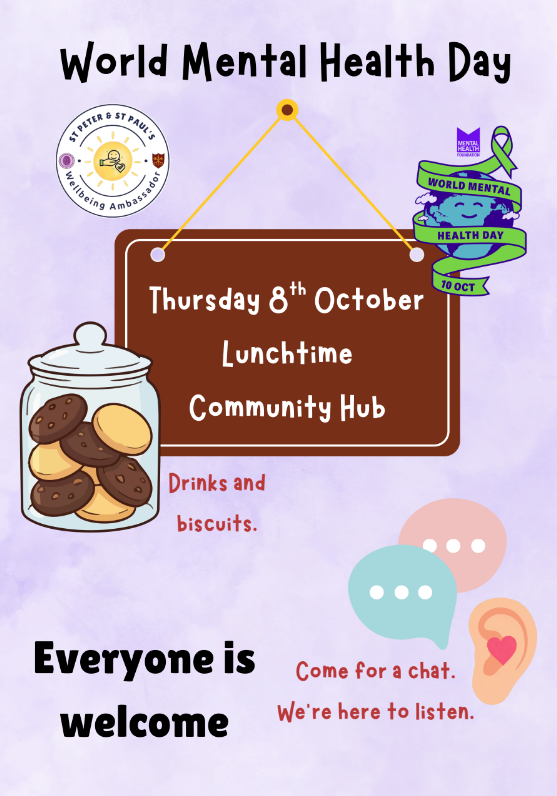
Meditation can be one method in which you can build time into your day to look after your mental health. Prioritising good mental health is important for every single one of us. World Mental Health Day falls this weekend, so during lunchtime on Thursday 8th October we are opening up the Community Hub and everyone is welcome to drop in for a drink, biscuit and a chat.
Keep safe, keep talking, and remember you are not alone. 💜🌍
Hail, Mary, full of grace, the Lord is with thee. Blessed art thou amongst women and blessed is the fruit of thy womb, Jesus. Holy Mary, Mother of God, pray for us sinners, now and at the hour of our death. Amen.
In the name of the Father and of the Son and of the Holy Spirit. Amen.
You are invited to begin by making the Sign of the Cross.
Response: In the name of the Father and of the Son and of the Holy Spirit. Amen.
Lots of the feedback from our recent prayer and liturgy form suggested that you would appreciate more time to draw, doodle and write. Today, as we focus on the Word of the Week (Rosary), I invite you to think about Jesus’ life from a different perspective; from the point of view of Mary, his mother.
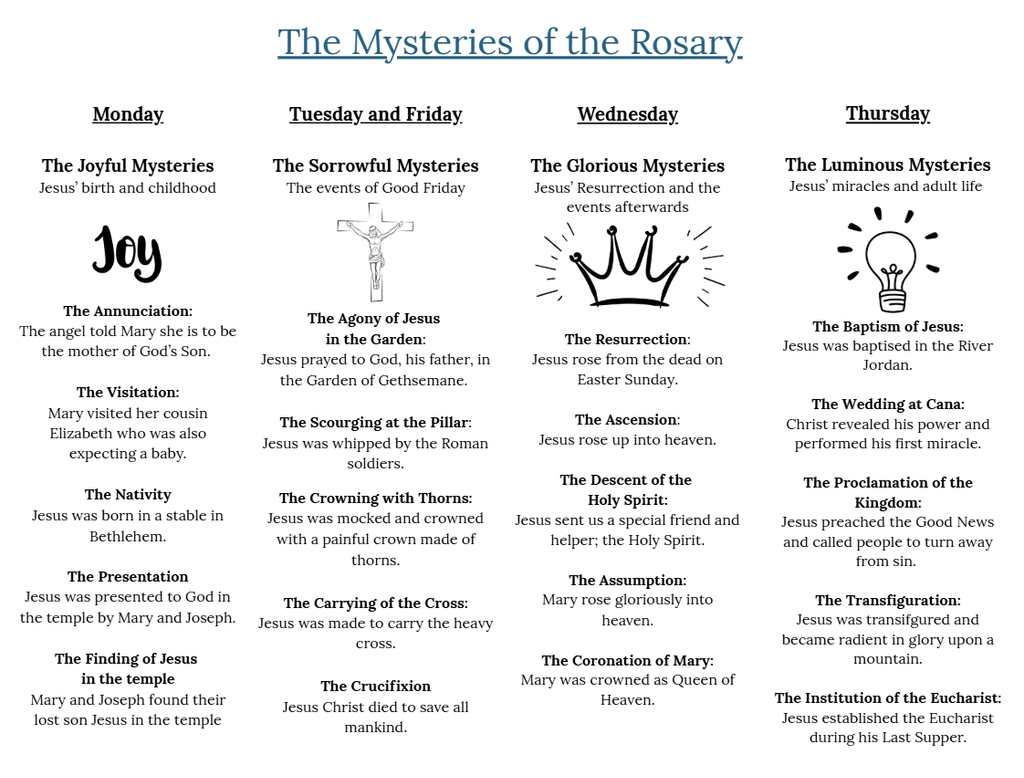
Depending on what day you are doing this session of the Living Word – choose one of the mysteries to reflect on and respond in your own chosen way.
Perhaps you will draw something that comes to mind when you think of this mystery, write down one word which best sums up that mystery or which describes the emotion it makes you feel or write a short comment to describe what Mary might have said or how she might have felt knowing her son experienced this.
You might choose to play this Marian hymn to create a peaceful and reflective environment whilst you complete this activity.
Hail, Mary, full of grace, the Lord is with thee. Blessed art thou amongst women and blessed is the fruit of thy womb, Jesus. Holy Mary, Mother of God, pray for us sinners, now and at the hour of our death. Amen.
In the name of the Father and of the Son and of the Holy Spirit. Amen.
Calling all Year 10’s, 11’s and 13’s for FLAME 2027!
On Saturday 6th March 2027, thousands of young people from across England and Wales will fill the iconic OVO Arena Wembley for the biggest Catholic youth gathering in the country: FLAME 2027! A jam-packed day of live music, dance, motivational speakers, praise and worship in a way you’ve never experienced before!
See the posters around school for more information or pop in to see Lucy in the Chaplaincy Office/Community Hub to ‘sign up’. There’s only about 20 spaces available! Register your interest directly with Lucy or with your Form Tutor ASAP!
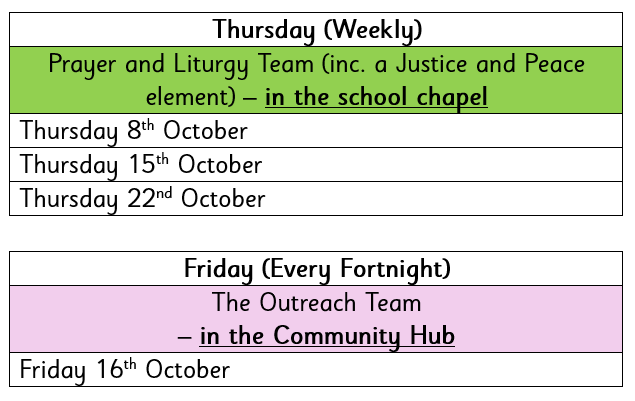
Chaplaincy Meetings – Starting this Thursday (8th October)
Still interested but haven’t handed a form in? Please speak to Lucy or your Form Tutor ASAP!
Your Form Tutors have been informed if anybody in their form has applied to be part of the Chaplaincy Teams. Here are the details for the meetings for the reminader of this term:
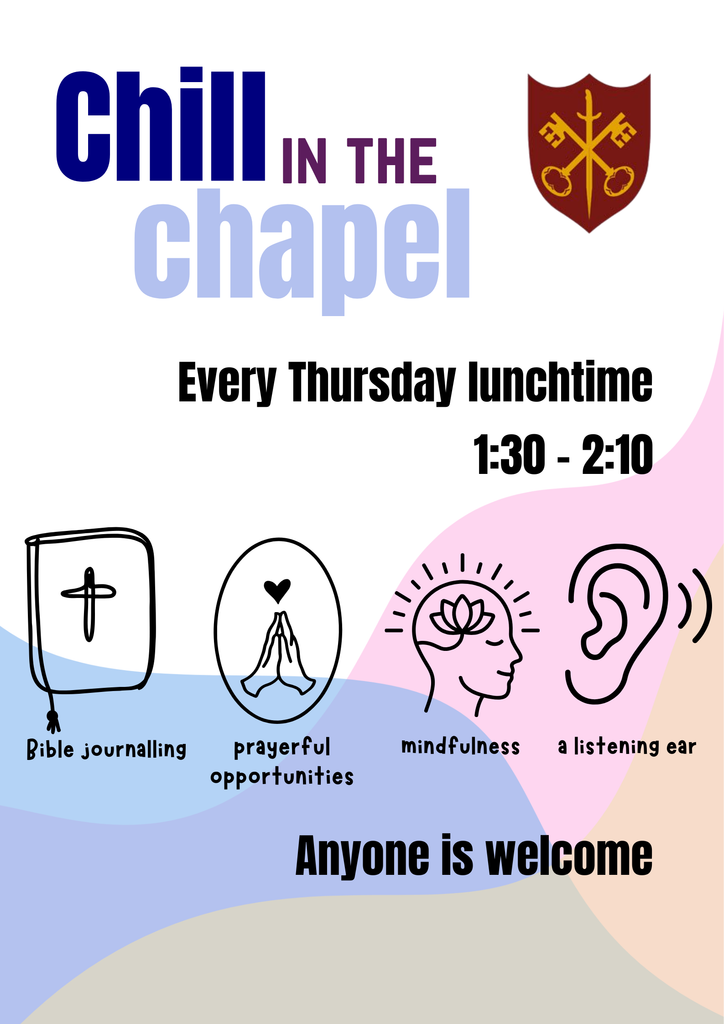
Are you looking for a quiet space to go at lunch time? Have you considered the chapel?
Our school chapel (at the bottom of the Humanities staircase) is a welcoming and inclusive space for everybody. You do not need to be Catholic to make use of the chapel. Although it is primarily a place of prayer and worship it is also a suitable space for quiet reflection and wellbeing.
Lucy will be in the chapel every Thursday lunchtime offering some wellbeing and mindfulness activities. Anyone is welcome. You don’t need to stay for the whole of lunch either, just call in for as long as you’d like to and make sure you eat before or after you come. Thank you.
Here are some resources to help you with the planning of Celebrations of the word.
Open Bible – Search the Bible by keyword for scripture suitable to your theme.
Planning sheets – Use the planning sheets on this page to plan your Celebration of the word. Remember that somebody else should evaluate on the same sheet (or on a second copy) during or shortly after your delivery.
Seasonal music – Hymns and worship songs recorded by members of the Trust Chaplaincy Team suitable for different seasons and themes throughout the liturgical year.
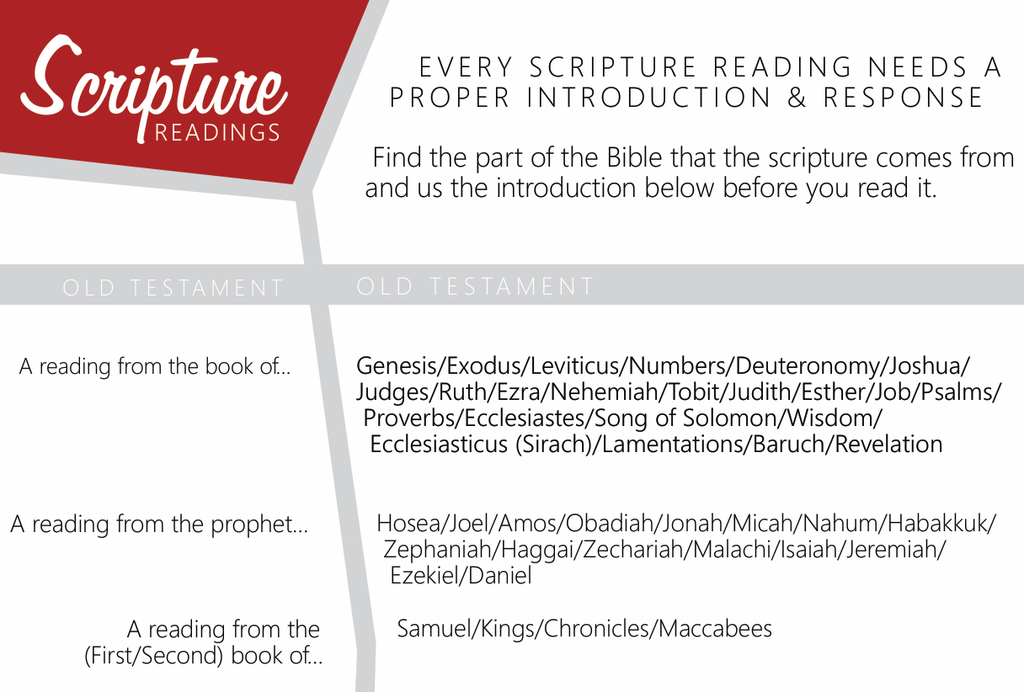
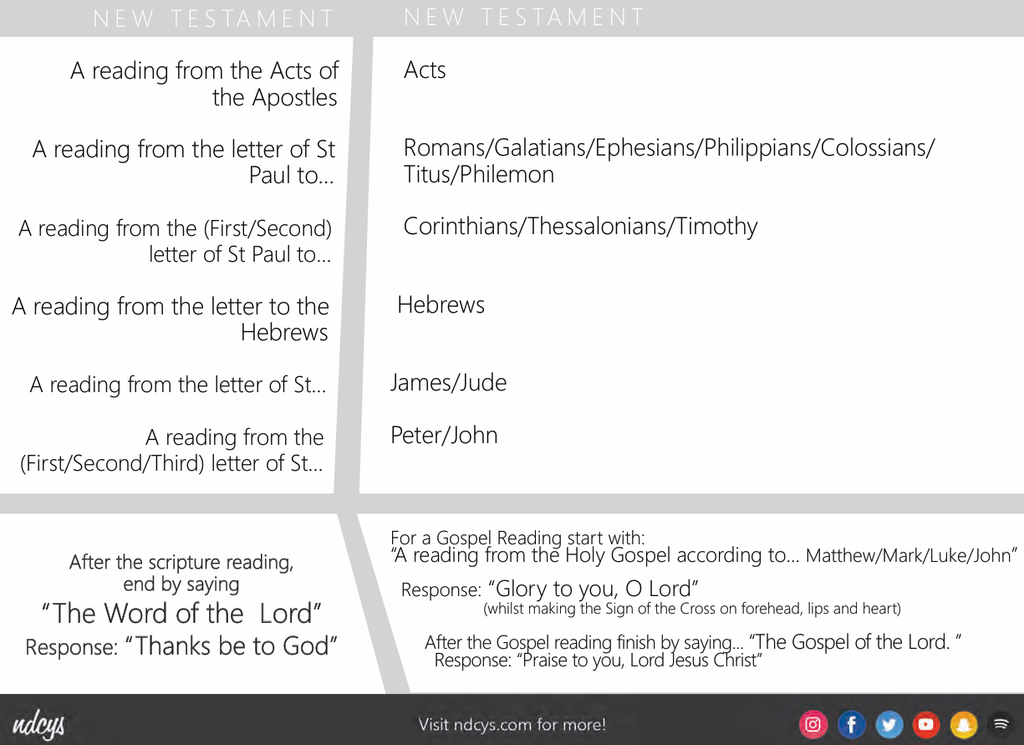
Introducing Scripture – It is very important that we give scripture the reverence it deserves. We should use translations taken from the English Standard Version at Saint Peter and Saint Paul’s. Ensure you choose this version if taking scripture from sites such as BibleGateway. Scripture should also be introduced and concluded correctly, depending on where in the Bible it comes from. A helpful guide can be found below. Please note the specific instructions and additions when scripture comes from one of the four Gospels (Matthew, Mark, Luke or John). Ordinarily, we stand for the Gospel and we stay seated for scripture which comes from elsewhere.




2 comments