Please remember to check the ‘Catholic Life and Chaplaincy Notices’ tab weekly!
Templates for this week’s mission activity are available from the Community Hub if you wish to collect a set to use.
Shout out for Flame 2027! Y10, 11 and 13: Watch the video in the Catholic Life and Chaplaincy Notices tab and register your interest with Lucy or via your Form Tutor ASAP.
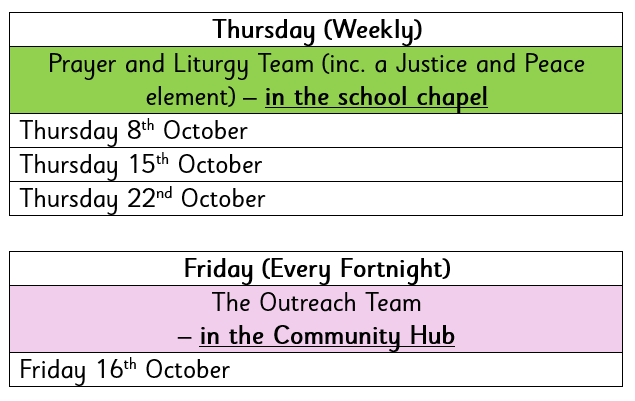
Helpful resources to support the planning and delivery of prayer and liturgy can also be found on our diocesan Chaplaincy website here.
Part 1 – Watch
Part 2 – Listen
Part 3 – Do
Catholic Life and Chaplaincy Notices
Useful Resources
| The Word of the Week is: | We are in: | The liturgical colour is: |
| Justice | Week 29 in Ordinary Time, Year A | Green |
You are invited to begin by making the Sign of the Cross.
Response: In the name of the Father and of the Son and of the Holy Spirit. Amen.

A reading from the Holy Gospel according to Matthew.
R./ Glory to you O Lord +
Then the Pharisees went and plotted how to entangle him in his words. And they sent their disciples to him, along with the Herodians, saying, “Teacher, we know that you are true and teach the way of God truthfully, and you do not care about anyone’s opinion, for you are not swayed by appearances. Tell us, then, what you think. Is it lawful to pay taxes to Caesar, or not?” But Jesus, aware of their malice, said, “Why put me to the test, you hypocrites? Show me the coin for the tax.” And they brought him a denarius. And Jesus said to them, “Whose likeness and inscription is this?” They said, “Caesar’s.” Then he said to them, “Therefore render to Caesar the things that are Caesar’s, and to God the things that are God’s.”
The Gospel of the Lord
R./ Praise to you Lord Jesus Christ.
When we look at the world, we quickly notice that things aren’t always fair. People are sometimes judged by their appearance, background, or social status. Rules can be applied unequally, and the loudest or most powerful voices often get the final say.
In Catholic tradition, justice is about treating people fairly and ensuring that everyone has what they need to live a dignified life. It isn’t just about punishment or strict rules; it’s about a balance which is rooted in human dignity, respect, and ensuring everyone has what they need to thrive.
In this week’s Scripture readings, Jesus teaches the people something which links to the themes of freedom and justice. When Jesus says the famous line, “Render to Caesar the things that are Caesar’s, and to God the things that are God’s,” he reminds us that God’s desire for fairness spans across all boundaries, cultures, and belief systems.
Jesus said we should give back to God what is God’s, but what did he mean? If the Roman coin belonged to Ceaser because Ceaser’s image was on it, what is stamped with God’s image?
You are! As Catholics, we believe that every person is made in the image and likeness of God. Let’s remind ourselves about what that means today by watching this video:
Watch from 0:00 – 2:18
Discussion Questions:
- What is the difference between treating everyone equally (the exact same) and treating everyone equitably or justly (giving everyone what they actually need)?
- Where in our school, your online spaces or within the local community do you see unfairness happening most often? Why do people hesitate to step in?
Click below to “Add Comment” and capture some of what has been said in your form for others to see or add them to your form scrapbook if you have one!

God of all creation, open our eyes to see the world as you see it. Help us to notice the people who are ignored, left out or treated unfairly. Give us the courage to look beyond our own comfort so that we can stand up for what is right and honour the dignity of every person we meet.
Amen.
In the name of the Father and of the Son and of the Holy Spirit. Amen.
You are invited to begin by making the Sign of the Cross.
Response: In the name of the Father and of the Son and of the Holy Spirit. Amen.
Let’s take a step back today and give you some time and space to truly reflect on what the Word of the Week means to you as an individual.
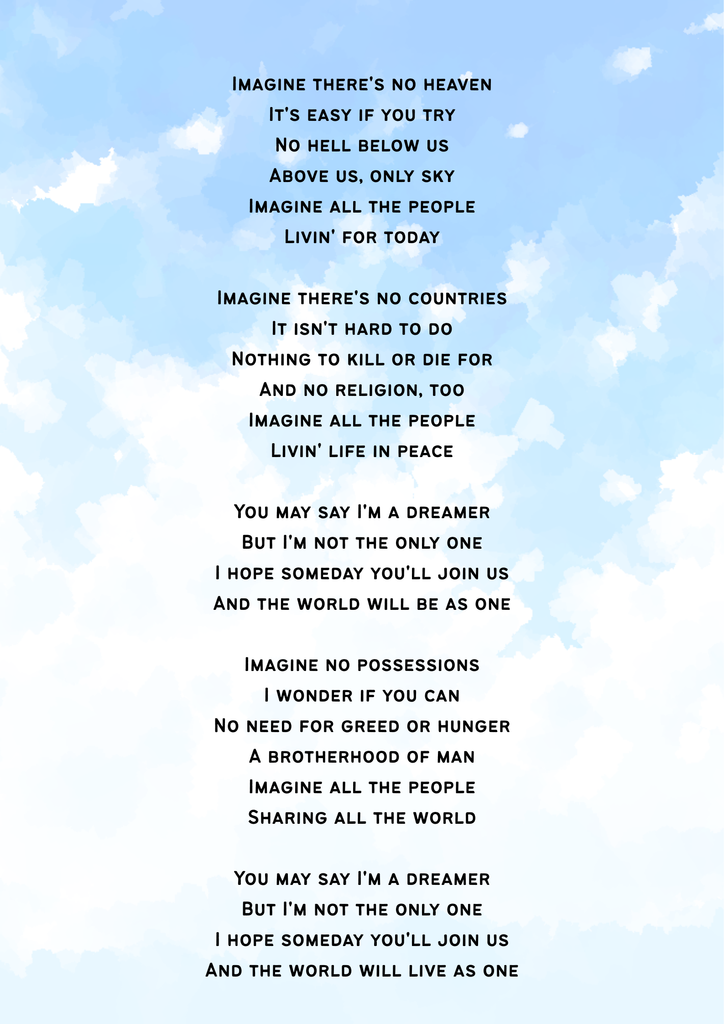
I invite you to listen to the song Imagine today by John Lennon.
When the song is played for the first time, simply listen and try to pick out some of the lyrics. Do they resonate with your own feelings towards the word ‘justice’ and what it means to you?
When the song is played again, look more closely at the lyrics. Which one creates the most powerful image to you? Which line or lines promote justice in a way which you think is most powerful? Can you explain your reasoning?
Dear God, help us to promote a fairer and more just world through our actions and words. Help us to be peacemakers who see all humans as our brothers and sisters made in your image and likeness. Help us to share generously and do everything in our power to make the world a better place. Amen.
In the name of the Father and of the Son and of the Holy Spirit. Amen.
You are invited to begin by making the Sign of the Cross.
Response: In the name of the Father and of the Son and of the Holy Spirit. Amen.
When we think about justice, we might think that it’s too bigger concept for us to get involved in, that there’s nothing we can do as individuals to make any significant change and that the responsibility to build a fairer and more just world lies only with world leaders. However, seemingly small choices and actions in our day-to-day life can promote justice and do make a difference.
Have your ever heard of the starfish story?
The Starfish Story
Inspired by The Star Thrower by Loren Eiseley (1969)
One day, a man was walking down the shoreline of a sandy beach as the sun was rising. A way ahead, he saw a young girl who bent down and picked up a starfish that had been washed ashore. As the man watched, he witnessed the girl do this several times as she came across more starfish lying on the sand.
As the man approached, he curiously asked her what she was doing. The girl smiled and replied, “I’m throwing these starfish back into the water. If I don’t throw them back, they’ll die!”
Surprised, the man said, “But there are thousands of starfish washed up on this beach. You can’t possibly save them all. Can’t you see that you won’t really make a difference?”
The girl, continuing to smile, bent down and picked up another starfish and gently returned it to the water before saying, “Well, I made a difference to that one!”
Catholic Social Teaching calls us to uphold the dignity of every single human person. Justice doesn’t require us to fix the entire world overnight; it asks us to render what is due – love, respect, fairness – to the person right in front of us.
To practice justice as teenagers, you can:
- Refuse to participate in gossip or exclusion.
- Stand up for a classmate who is being picked on.
- Share our time and privileges with those who need support.
- Fulfil our obligations (e.g. jobs to help at home, deadlines for homework) with honesty and care.
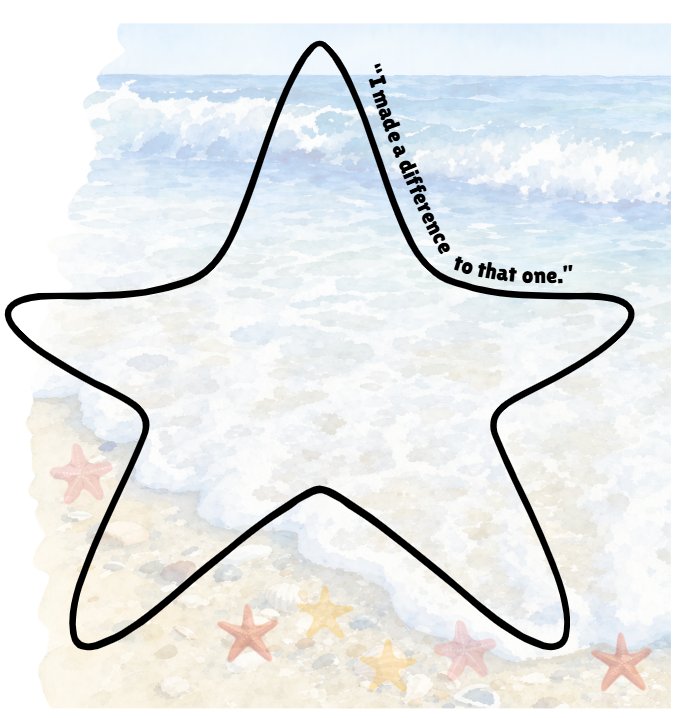
Your mission:
Either using Post-It Notes or the starfish templates available from the Community Hub, write down one idea of how you can promote justice in your day-to-day life, not through grand actions but through small actions of kindness. How can you make school and our local community fairer and more just places?
Lord, make me an instrument of your justice: When the world’s problems feel too big, remind me of the power of caring for one person. Where there is exclusion, let me offer welcome. Where there is gossip, let me speak truth and kindness.
Amen.
In the name of the Father and of the Son and of the Holy Spirit. Amen.
Calling all Year 10’s, 11’s and 13’s for FLAME 2027!
On Saturday 6th March 2027, thousands of young people from across England and Wales will fill the iconic OVO Arena Wembley for the biggest Catholic youth gathering in the country: FLAME 2027! A jam-packed day of live music, dance, motivational speakers, praise and worship in a way you’ve never experienced before!
See the posters around school for more information or pop in to see Lucy in the Chaplaincy Office/Community Hub to ‘sign up’. There’s only about 20 spaces available! Register your interest directly with Lucy or with your Form Tutor ASAP!
Are you looking for a quiet space to go at lunch time? Have you considered the chapel?
Our school chapel (at the bottom of the Humanities staircase) is a welcoming and inclusive space for everybody. You do not need to be Catholic to make use of the chapel. Although it is primarily a place of prayer and worship it is also a suitable space for quiet reflection and wellbeing.
Lucy will be in the chapel every Thursday lunchtime offering some wellbeing and mindfulness activities. Anyone is welcome. You don’t need to stay for the whole of lunch either, just call in for as long as you’d like to and make sure you eat before or after you come. Thank you.

Here are some resources to help you with the planning of Celebrations of the word.
Open Bible – Search the Bible by keyword for scripture suitable to your theme.
Planning sheets – Use the planning sheets on this page to plan your Celebration of the word. Remember that somebody else should evaluate on the same sheet (or on a second copy) during or shortly after your delivery.
Seasonal music – Hymns and worship songs recorded by members of the Trust Chaplaincy Team suitable for different seasons and themes throughout the liturgical year.
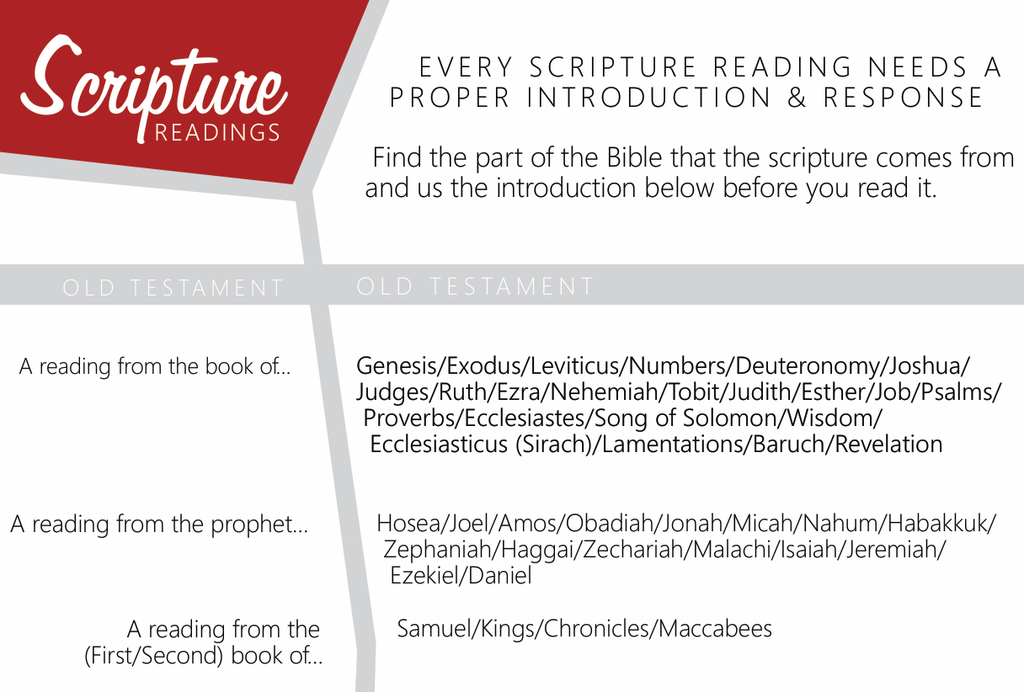
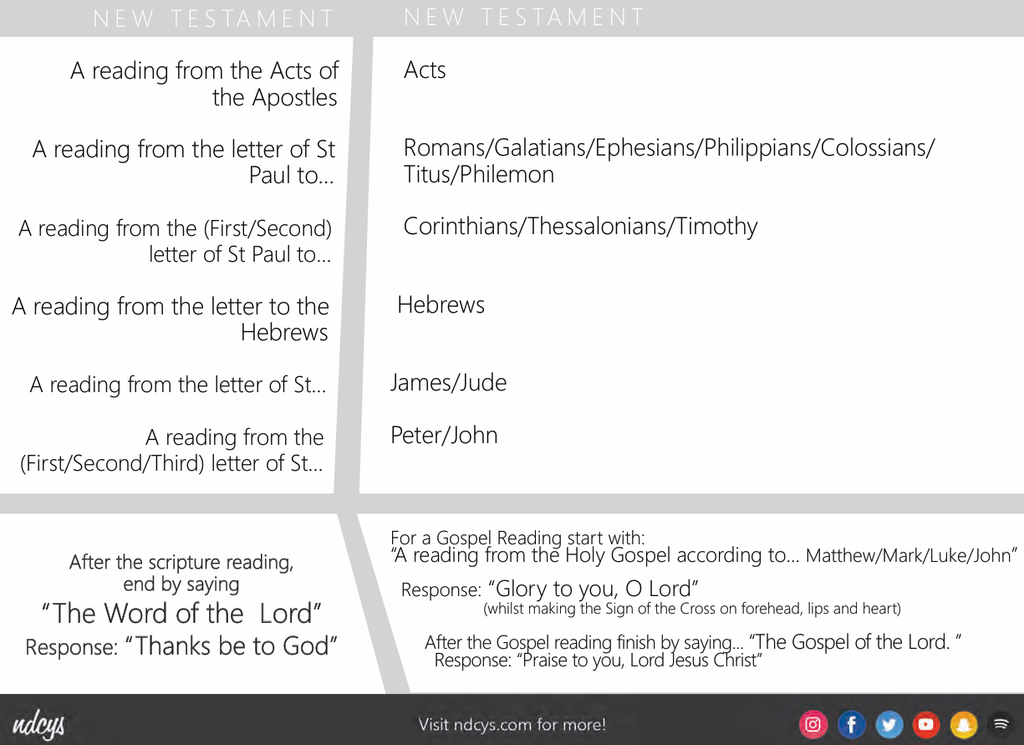
Introducing Scripture – It is very important that we give scripture the reverence it deserves. We should use translations taken from the English Standard Version at Saint Peter and Saint Paul’s. Ensure you choose this version if taking scripture from sites such as BibleGateway. Scripture should also be introduced and concluded correctly, depending on where in the Bible it comes from. A helpful guide can be found below. Please note the specific instructions and additions when scripture comes from one of the four Gospels (Matthew, Mark, Luke or John). Ordinarily, we stand for the Gospel and we stay seated for scripture which comes from elsewhere.


Post Comment