Welcome to this week’s Living Word!
Our Word of the Week is Faith.
Welcome back! During the break, Christians celebrated the resurrection of Jesus on Easter Sunday and we are now in the liturgical season of Eastertide. Eastertide is the most celebratory and important liturgical season in the Church’s year. Following the 40 days and nights of preparation in Lent, Eastertide is focused on the Resurrection of Jesus, and reflects on the themes of new life, victory over death, and the fulfilment of scriptural prophecies. The season is visually marked by the use of white and gold liturgical colours to signify joy.
Section 1: The Mystery of Faith
We invite you to start with the Sign of the Cross.
Response: In the name of the Father and of the Son and of the Holy Spirit, Amen
A reading from the Holy Gospel according to Luke.
R./ Glory to you O Lord. +
While they were talking and discussing together, Jesus himself drew near and went with them. But their eyes were kept from recognising him…
And he vanished from their sight. They said to each other, “Did not our hearts burn within us while he talked to us on the road, while he opened to us the Scriptures?”
The Gospel of the Lord
R./ Praise to you Lord Jesus Christ.
The men on the road were simply two depressed friends walking away from a traumatic experience and a great loss. They had lost all hope. They didn’t recognise Jesus at first because he just looked like a regular traveller. His identity was a mystery to them.
At every Mass, we hear the priest say the words, “The Mystery of Faith.” Usually, a ‘mystery’ is a puzzle we solve in order to find the answer and put our minds at rest. But in the Church, a mystery is something so big that we can never get to the bottom of it.
How does this link to our Word of the Week? Faith isn’t about seeing miracles; it’s about noticing the “burning in your heart” when someone says something true, or when you feel a sense of peace you can’t quite explain.
Discussion Questions:
- The disciples felt their “hearts burning” before they actually realised who Jesus was. Have you ever had a gut feeling or a sense of peace that you couldn’t explain with logic alone? What happened?
- If God is everywhere, why do you think it is often so hard to recognise Him in the middle of a normal school day? What are the distractions that prevent our eyes from seeing?
- Our previous pope, Pope Francis, often said that “the heart has reasons that the mind does not understand.” Do you think it is possible to know something is true even if you can’t prove it in a science lab?
Click below to “Add Comment” and capture some of what has been said in your form for others to see or add them to your form scrapbook if you have one!

Lord, sometimes our eyes are closed to the beauty and the truth right in front of us. When we are confused or feel stuck, help our hearts to stay open. Give us the courage to trust the “burning” within us and the curiosity to keep looking for you in the faces of the people we meet. Amen.
Section 2: ‘The People’s Pope’
We invite you to start with the Sign of the Cross.
Response: In the name of the Father and of the Son and of the Holy Spirit, Amen.
This week marks the first anniversary of the death of Jorge Mario Bergoglio, better knowns as Pope Francis. He was a man who believed that faith wasn’t a set of rules, but a “culture of encounter.” Today we remember how he changed the way the world sees the Church.
Pope Francis famously said the Church should be a “Field Hospital” after a battle. He didn’t care about your high grades and your greatest successes; he cared about your troubles and wounds. He spent his life visiting prisons and refugee camps, and comforting the sick and lonely because he believed that’s where the “Living Word” actually lives.
Even if you wouldn’t describe yourself as religious, Pope Francis’s challenge to “look the poor in the eye” is a challenge for all of us. He believed faith was a verb: to go, to heal, to love.
The simple lyrics of this song remind us of God’s constant love and faithfulness, helping us to understand that God is always close by as a caring father and a faithful friend.
As you listen, think about the following questions:
- The song says, “All my life You have been faithful.” If you look back at your hardest week of this year so far, can you identify one small moment where you were supported or held by someone?
- Pope Francis taught that God is found on the edges or in the unexpected. Where in your life or in our school do you see goodness where others might not expect to find it?
- What is one small, silent thing you could do for someone else today to bring goodness into their life?
Prayer: Let us pause for a moment of silence.
Loving Father, we thank you for the life of Pope Francis and the way he showed us your goodness in the simplest of ways. May we never become indifferent to the people around us. Help us to put our faith into action through works of love and mercy. Amen.
Section 3: “My Lord and My God.”
We invite you to start with the Sign of the Cross.
Response: In the name of the Father and of the Son and of the Holy Spirit, Amen

A reading from the Holy Gospel according to Luke.
R./ Glory to you O Lord. +
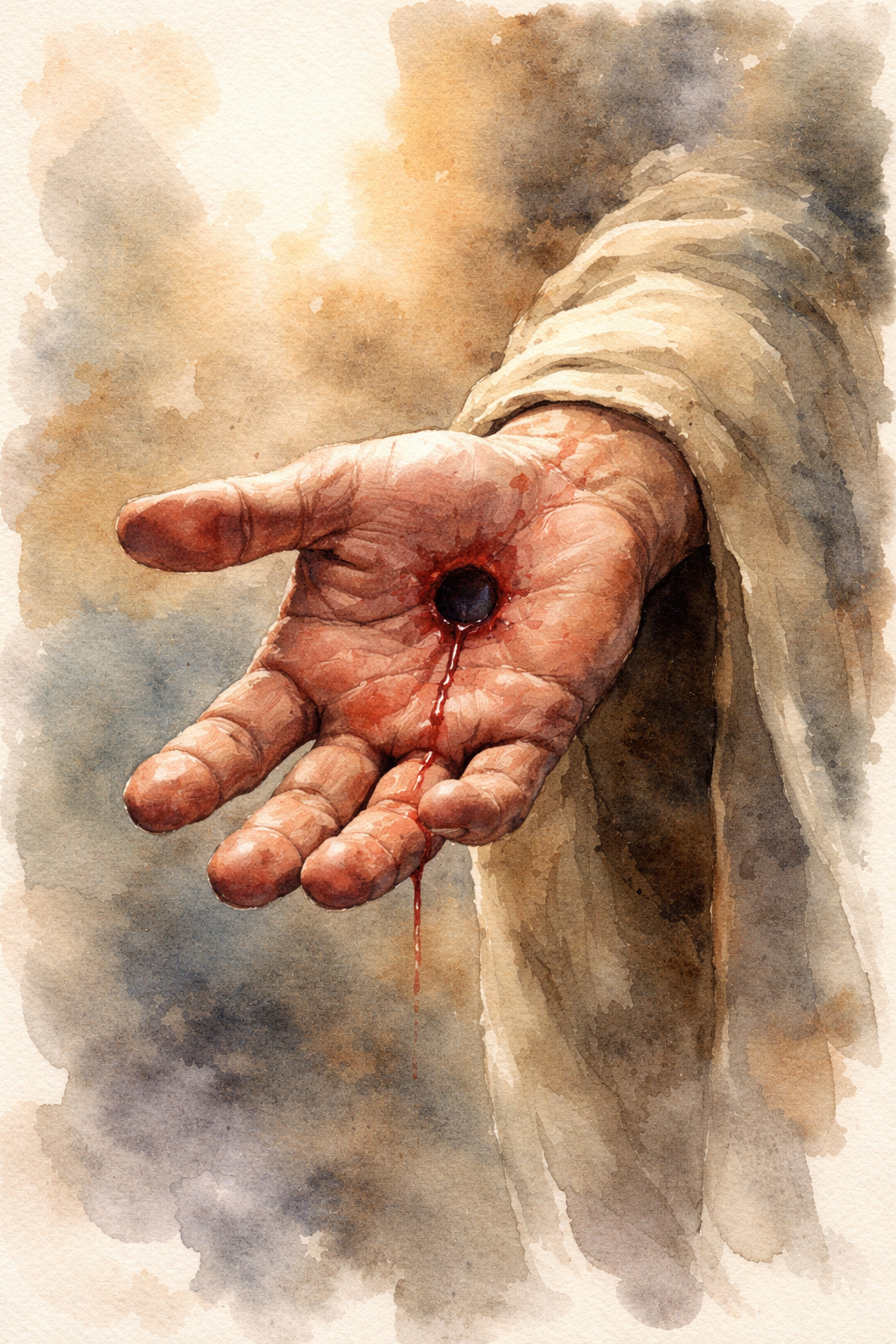
As they were talking about these things, Jesus himself stood among them, and said to them, “Peace to you!” But they were startled and frightened and thought they saw a spirit. And he said to them, “Why are you troubled, and why do doubts arise in your hearts? See my hands and my feet, that it is I myself. Touch me, and see.”
The Gospel of the Lord
R./ Praise to you Lord Jesus Christ.
Even one of Jesus’ closest friends, the disciple Thomas, doubted that Jesus had truly risen when the other disciples told him they had seen the risen Christ for themselves. He said he wouldn’t believe that Jesus had risen from the dead unless he could put his finger into the holes which were made in Jesus’ hands by the nails when he was crucified. When Jesus appeared before Thomas and invited him to do just that, Thomas found that he no longer needed to. He simply said, “My Lord and my God,” but Jesus replied, “Have you believed because you have seen me? Blessed are those who have not seen and yet have believed.”
The Response
One of my favourite literary quotes comes from Dan Brown’s Angels and Demons. The main character Robert Langdon, when questioned on the topic of faith whilst visiting the Vatican, simply states,
“My mind tells me I will never understand God. And my heart tells me I am not meant to.”
The disciples desperately wanted Jesus to stay with them, but he had to go back to heaven to be with his Father. They would soon be given the challenge to spread the Good News through words and actions alone, without the physical proof which Thomas once demanded. Yet many people still choose to believe and place their faith in something greater.
The Activity: “I don’t understand… yet.”
On a Post-it note, write down one thing about the world, suffering, or God that your mind cannot wrap itself around (e.g. “Why do good people suffer?” or “How can God be eternal?”) and which makes having faith difficult. Add some to your scrapbook. If there’s time, your teacher could share some of these aloud anonymously.
Thomas’ doubt wasn’t a sin, just as our questions today aren’t either. Thomas found his faith when he stopped arguing and said, “My Lord and my God.”
Faith isn’t the absence of questions; it’s the decision to keep walking even when you don’t have all the answers.
Dear God, We thank you for the gift of our minds: for our curiosity, our questions, and even our doubts. We thank you for Saint Thomas, who reminds us that it is okay to seek the truth and to ask to see your face. We offer you the questions we cannot answer and the burdens we cannot carry. In the silence of our hearts, meet us where our understanding ends. Amen.


Post Comment