Welcome to this week’s Living Word!
Our Word of the Week is Example.
An example is a model of behaviour. It is something that we can look to in order to learn how to live our lives. The lives of saints, and other holy men and women, remind us that we are called to follow the example of Jesus Christ. We too, should also be an example to others by trying to live life of love, service, and forgiveness.
Section 1: Made in God’s Image and Likeness
We invite you to start with the Sign of the Cross.
Response: In the name of the Father and of the Son and of the Holy Spirit, Amen
A reading from the Holy Gospel according to John.
R./ Glory to you O Lord. +
“If you love me, you will keep my commandments. And I will ask the Father, and he will give you another Helper, to be with you forever, even the Spirit of truth, whom the world cannot receive, because it neither sees him nor knows him. You know him, for he dwells with you and will be in you.
“I will not leave you as orphans; I will come to you. Yet a little while and the world will see me no more, but you will see me. Because I live, you also will live. In that day you will know that I am in my Father, and you in me, and I in you. Whoever has my commandments and keeps them, he it is who loves me. And he who loves me will be loved by my Father, and I will love him and manifest myself to him.”
The Gospel of the Lord
R./ Praise to you Lord Jesus Christ.
“You know him, for he dwells with you and will be in you.” (John 14: 17b)
The Catholic Social Teaching principle of Human Dignity reminds us that every single person is worthy of respect and dignity because every single one of us is a child of God. Scripture tells us that every one of us is made by God in His image and likeness (Genesis 1:26) and that each one of us is “fearfully and wonderfully made” (Psalm 139:14). Sometimes, our human nature makes us doubt ourselves; our likeability, our talents, our worth.
In the scripture today, Jesus set us the ultimate example of accompaniment. He does not leave us to face our mental or spiritual battles alone; He provides the Holy Spirit as a constant companion. This week is Mental Health Awareness Week which is a week dedicated to highlighting the important of positive mental health and advocating for speaking out when you feel worried, upset, lonely or overwhelmed.
Using the PowerPoint slides which Mrs McNulty has shared, spend some time familiarising yourself with what is going on in school this week for Mental Health Awareness Week. Make a start on the quiz. To make this more manageable, you could do 10 questions a day – remember that Mrs McNulty has offered a small prize for the form with the highest score in the quiz!
Lord, thank you for the example of your abiding presence. When I feel lonely or overwhelmed, remind me that I am never alone. Help me to see my own dignity through your eyes. Amen.
Section 2: The Example of Reasoned Hope
We invite you to start with the Sign of the Cross.
Response: In the name of the Father and of the Son and of the Holy Spirit, Amen.
We are called to be an example of hope. This isn’t about not acknowledging that things are challenging sometimes or trying to argue that bad things don’t happen, but rather a reasoned hope that acknowledges suffering while pointing toward the Resurrection.
Gentleness and reverence are key to both Mental Health Awareness and Catholic Social Teaching. Treating ourselves and others with reverence prevents the stigma that often strips people of their dignity, for example if they are suffering with their mental health.
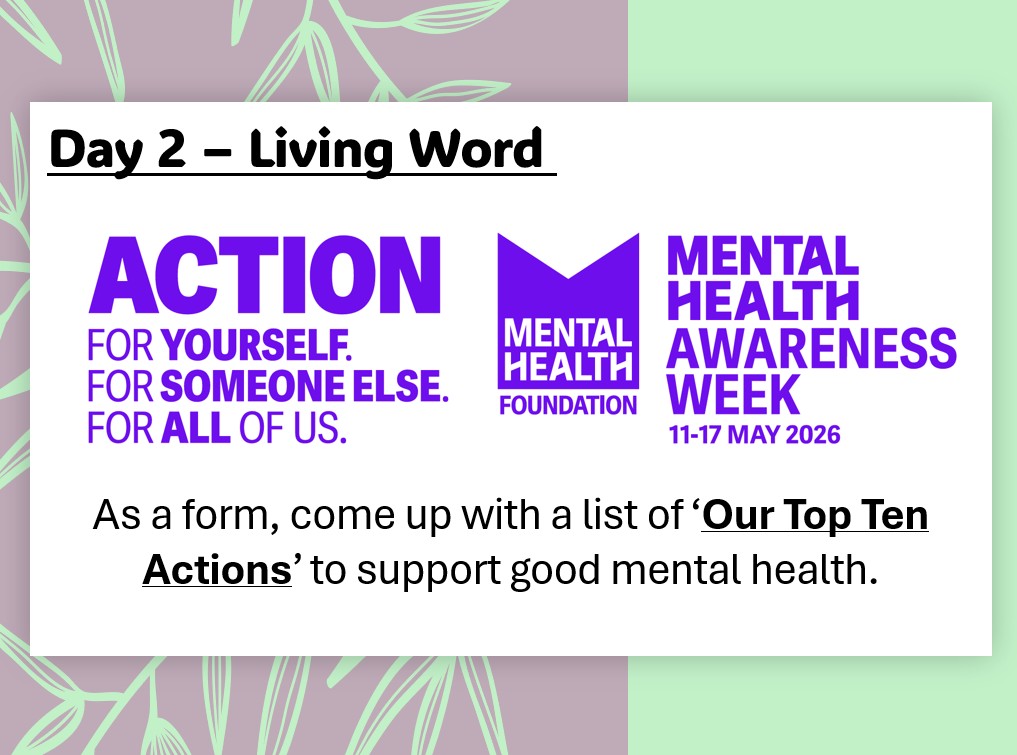
In the spirit of being an example of reasoned hope, your activity today is to use the resource provided by Mrs McNulty to work together to think of and record ten actions to support good mental health. Each reflects our inherent dignity and the gentleness we owe to our minds and bodies.
Prayer: Let us pause for a moment of silence.
Lord, help me to be an example of your peace. Grant me the wisdom to treat my own mind and heart with the same gentleness and reverence you show to me. May my wellbeing be a testament to the dignity you have given me and every other person. Amen.
Section 3: The Example of Joyful Witness
We invite you to start with the Sign of the Cross.
Response: In the name of the Father and of the Son and of the Holy Spirit, Amen

A reading from the Holy Gospel according to John.
R./ Glory to you O Lord. +
“I will not leave you as orphans; I will come to you…
Whoever has my commandments and keeps them, he it is who loves me. And he who loves me will be loved by my Father, and I will love him and manifest myself to him.”
The Gospel of the Lord
R./ Praise to you Lord Jesus Christ.
Jesus provides the ultimate example of how love is not just a feeling, but an observation of his commandments. The greatest commandment is to love God and the second is like it; to love our neighbour as ourselves. When we protect the mental health of others, we are observing Christ’s law of love.
Human dignity is not lived in isolation. We have a responsibility to create a society where everyone has the resources to stay mentally healthy. Advocacy is a powerful way to live out our faith and demonstrate the Catholic Social Teaching of solidarity with those who feel like ‘orphans’ in our current system. Solidarity means to use our words and actions to show others that we care.
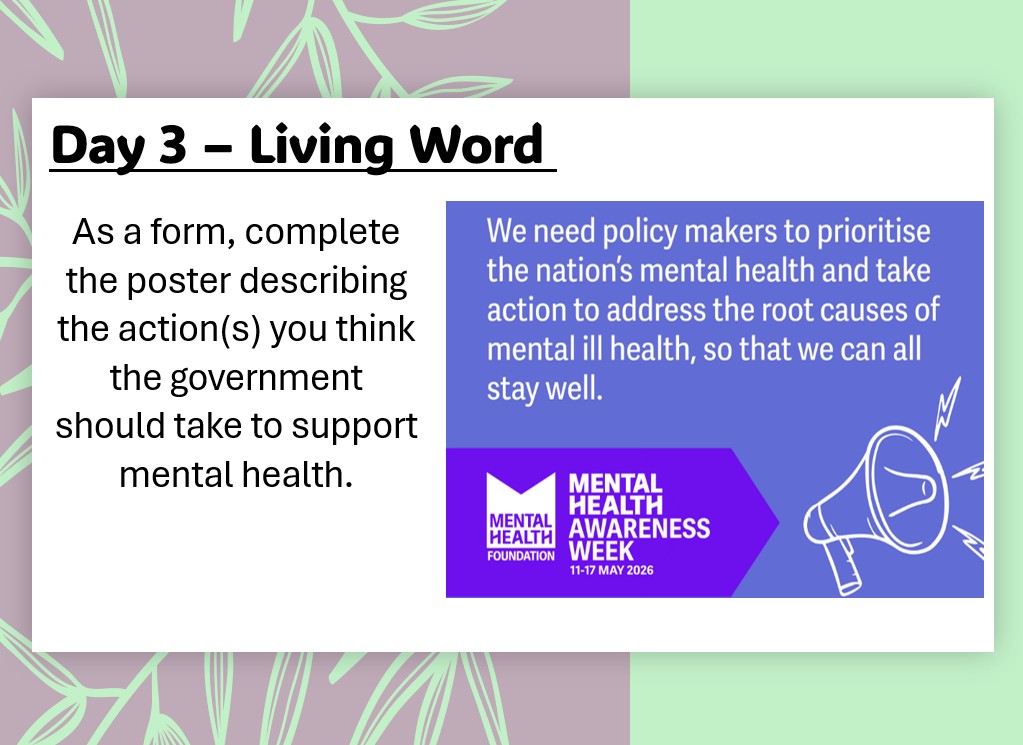
In the spirit of Christ’s example of active love and his promise to never leave us abandoned, you activity today is to use the resource provided by Mrs McNulty to record your idea(s) about how our wider society (and those who lead it) can support mental health.
Lord, you gave us the example of a love that acts and a promise that never fails. Help us to be your hands and feet in the world today. Give us the courage to speak up for those who are struggling in silence and to demand a society where every person’s dignity is honoured. May our work for justice be a witness to your love, ensuring that no one is left to face their battles alone. Amen.


Post Comment