Welcome to this week’s Living Word.
The Word of the Week this week is Acceptance.
This word links in brilliantly to our Culture and Diversity which is taking place in school this week. Acceptance is the ability to see and appreciate people for who they are, without judgment. It helps us to build relationships and live in peace with each other. Acceptance comes from the knowledge that all people are loved and valued by God without exception. Catholic Social Teaching reminds us that every person is worthy of human dignity. We can’t get along with everybody, but we do have a responsibility to accept others for who they are; for their skin colour, their language, their culture, their religious beliefs or whatever makes them who they truly are. We are one family in Christ.
Section 1: My Culture, My Story – To be used alongside Mrs McNulty’s PowerPoint
We invite you to start with the Sign of the Cross.
Response: In the name of the Father and of the Son and of the Holy Spirit, Amen
A reading from the First Letter of Saint Paul to the Corinthians
(12:12, 21-23, 25-27)
“For just as the body is one and has many members, and all the members of the body, though many, are one body, so it is with Christ… The eye cannot say to the hand, “I have no need of you,” nor again the head to the feet, “I have no need of you.” On the contrary, the parts of the body that seem to be weaker are indispensable, and on those parts of the body that we think less honourable we bestow the greater honour… that there may be no division in the body, but that the members may have the same care for one another. If one member suffers, all suffer together; if one member is honoured, all rejoice together.
Now you are the body of Christ and individually members of it.
The Word of the Lord
R./ Thanks be to God.

Our school is a wonderfully diverse place! Spend some time today reflecting on and discussing these questions.
Discussion Questions:
How do you feel that your own culture or identity is best represented?
- Through a tradition, celebration, or habit that matters to you?
- Through a food item or meal, song, or object that feels meaningful?
- Through a value or belief that shapes who you are?
Click below to “Add Comment” and capture some of what has been said in your form for others to see or add them to your form scrapbook if you have one!

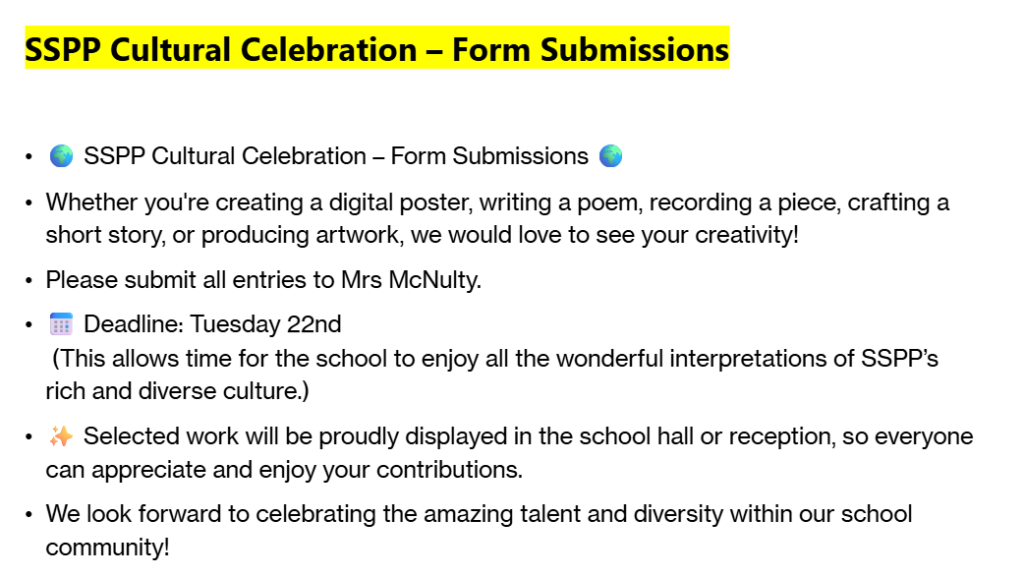
Don’t forget to look out for opportunities to get involved around school this week.
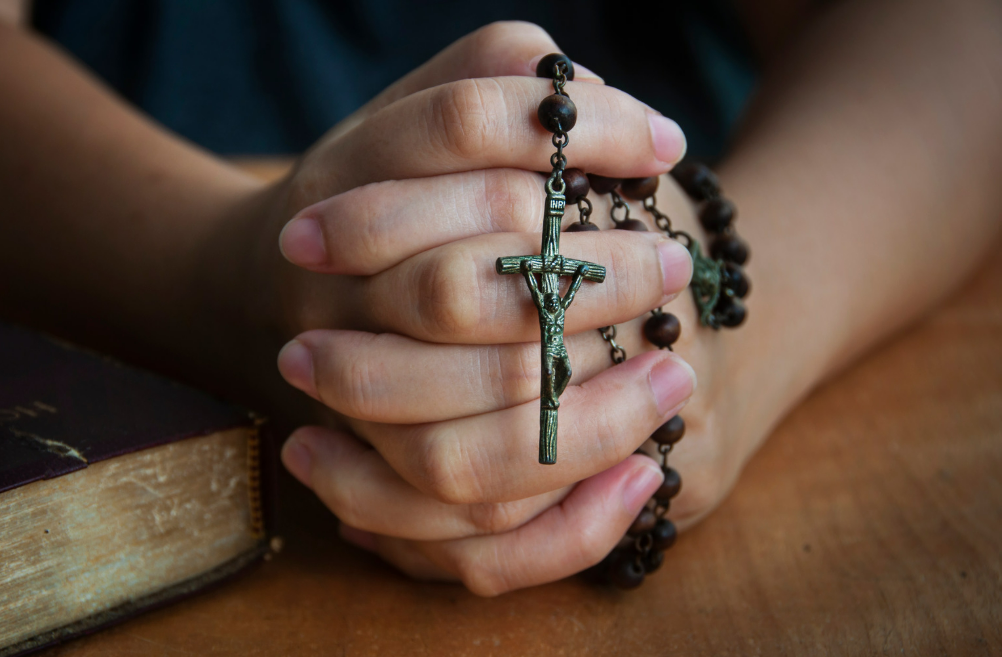
Loving Father, you knew each one of us before we were even born. Help us to accept one another and to recognise that every single person dignity and purpose. Amen.
Section 2: Acceptance – Seeing as God Sees
We invite you to start with the Sign of the Cross.
Response: In the name of the Father and of the Son and of the Holy Spirit, Amen.
We invite you to start with the Sign of the Cross.
Human acceptance usually looks like conformity – forcing yourself or others to fit into a mould. Divine acceptance is transformation — seeing the hidden, God-given reality of a person or situation and moving completely past the exhausting game of trying to fit.
Think about the people Jesus chose to hang out with: tax collectors, political outcasts, and people who made mistakes (like Peter). He didn’t wait for them to clean up their acts before welcoming them to the table. His acceptance came first, and that security is what gave them the power to change.
As humans, we often make our first judgements based on what we can see. But God doesn’t look at the surface; He looks at the heart. This week, during Culture and Diversity week, you might hear a lot of talk and celebration regarding our unique backgrounds, cultures, and identities. Your challenge is to remember that true acceptance happens when we stop trying to filter ourselves or edit our backgrounds to fit into someone else’s definition of ‘cool’ or ‘normal’, and instead start looking at people -and ourselves – the way God does.
Lord Jesus, it is often too easy to focus entirely on who is fitting in, who looks the part, and who is doing well. During this diversity week, help us to drop the filters. Give us your eyes to see the incredible, unique value in the people around me, and help us to accept the way you uniquely created each of us. Amen.
Section 3: The Feast of Saint Peter and Saint Paul
Send a student to the Community Hub (near Mr Ellis’ office) to collect one paper fish from the wicker basket on the prayer table – you’ll need these later today.
We invite you to start with the Sign of the Cross.
Response: In the name of the Father and of the Son and of the Holy Spirit, Amen
On the 29th June every year, the Catholic church celebrates the feast day of Saint Peter and Saint Paul. Since our school and church are dedicated to these two saints, we call them our patron saints and 29th June is therefore our patronal feast day. 29th June falls on a Monday this year and therefore the celebration is transferred to the Sunday. This feast day is a Holy Day of Obligation because Peter and Paul are such important saints. This means Catholics are obliged to go to church to celebrate this special occasion.
In school this year, we will celebrate a whole school Mass with members of our Catholic primary schools and with parishioners on Friday 26th June at 9:30am in SSPP church. This is also the final day of our Culture and Diversity Week.
Saint Peter and Saint Paul were both examples of missionary disciples. We’ll hear more about them and their stories in Mass on Friday, however it’s important to know that neither of them had always made the right choices in the past. Peter denied even knowing Jesus during his passion on Good Friday, insisting not once but three times that he did not know Jesus and was not his friend! Paul hated Christians and actively sought them out to persecute them until he encountered Jesus on the road the Damascus and had a life-changing experience. Why is this important? Because it shows that Jesus calls us all to follow him and that he always welcomes us back when we are humble enough to recognise when we do the wrong thing, say sorry and have the courage to try again. God’s grace can save anyone, and the call to missionary discipleship isn’t just about following a list of rules! It is about a total shift in how we engage with the world, how we treat other people, and how we see our own worth.

“Follow me, and I will make you fishers of men.”
– Matthew 4:19
In your form groups, work together to collect ideas about how we as a school or you as individuals can act as missionary disciples in the world today, specifically by how you can show acceptance towards one another and make people feel welcome.
Write some of these ideas on your fish template and add this to your scrapbook.
God of our past, present and future, we thank you for the inspiring examples of Saints Peter and Paul. Like Peter, help us to be strong pillars of support for one another. Like Paul, fire us up with the energy to make a positive difference. Bless our school community as we celebrate our patronal feast day. May our school be a place of welcome, acceptance, forgiveness, learning, and love. Amen.




2 comments