Please remember to check the ‘Catholic Life and Chaplaincy Notices’ tab weekly!
Lucy, the Lay Chaplain at Saint Peter and Saint Paul’s, is always keen to hear new ideas regarding the Living Word. If you’d like to get involved, you’d be very welcome to do so.
Helpful resources to support the planning and delivery of prayer and liturgy can also be found on our diocesan Chaplaincy website here.
Day 1 – Actions Speak Louder Than Words
Day 2 – Outreach Through Forgiveness
Day 3 – Living Water
Catholic Life and Chaplaincy Notices
Useful Resources
| The Word of the Week is: | We are in: | The liturgical colour is: |
| Outreach | Week 24 in Ordinary Time, Year A | Green |
You are invited to begin by making the Sign of the Cross.
Response: In the name of the Father and of the Son and of the Holy Spirit. Amen.
Our faith doesn’t just stay within the walls of the RE classroom, school grounds or church building; it’s meant to be shared! As the video this week explains, outreach is all about taking our faith into the world and sharing God’s love with those who need it most. This could be through donating to the school foodbank, volunteering with a community project, or simply being a listening ear to a friend. When we reach out to others and offer them kindness and hope, we not only serve them, but we also strengthen our own faith and connection to God.

A reading from the letter of Saint James.
What good is it, my brothers, if someone says he has faith but does not have works? Can that faith save him? If a brother or sister is poorly clothed and lacking in daily food, and one of you says to them, “Go in peace, be warmed and filled,” without giving them the things needed for the body, what good is that? So also faith by itself, if it does not have works, is dead.
The Word of the Lord.
R./ Thanks be to God.
Catholic outreach isn’t about trying to convert people through debate; it’s about making the world fairer and kinder through hands-on service. This is what Catholics call the Corporal Works of Mercy: feeding the hungry, comforting the lonely, and standing up for people who get pushed aside. When you show up for someone in need, you don’t need a fancy religious speech. Your hands and feet do the talking. In Catholic theology, when you serve a person who is suffering, you aren’t just doing somebody a nice favour… you are directly encountering Jesus Christ (“Truly, I say to you, as you did it to one of the least of these my brothers, you did it to me.” – Matthew 25:40).
The principles of Catholic Social Teaching help us with this. We are called to uphold the human dignity of every person, to give preferential option to the poor (that means put those people who are most in need first), to be peacemakers and to work for the common good.
Discussion Questions:
- Who is someone in your life (a coach, grandparent, friend, teacher) who rarely brags about themselves but constantly helps others? What makes their example so powerful?
- If you do a good deed and don’t post it online, does it feel less rewarding? Why do we feel such a strong urge for public approval?
- The word “Mass” comes from the Latin Ite, missa est which means “Go, you are sent!” How does taking part in Mass give a Catholic the energy to serve others during the week?
Click below to “Add Comment” and capture some of what has been said in your form for others to see or add them to your form scrapbook if you have one!

Perform one act of practical service today where nobody catches you and you receive zero thanks or credit. Clean up something even though you didn’t create the mess, pay for someone’s coffee or snack anonymously, or do something to help in the classroom or at home before being asked.
A Prayer by Saint Teresa of Avila:
Christ has no body but yours,
No hands, no feet on earth but yours,
Yours are the eyes with which he looks
Compassion on this world,
Yours are the feet with which he walks to do good,
Yours are the hands, with which he blesses all the world.
Yours are the hands, yours are the feet,
Yours are the eyes, you are his body.
Christ has no body now but yours.
Amen.
In the name of the Father and of the Son and of the Holy Spirit. Amen.
You are invited to begin by making the Sign of the Cross.
Response: In the name of the Father and of the Son and of the Holy Spirit. Amen.
A reading from the Holy Gospel according to Matthew.
R./ Glory to you O Lord. (+)
Then Peter came up and said to him, “Lord, how often will my brother sin against me, and I forgive him? As many as seven times?” Jesus said to him, “I do not say to you seven times, but seventy-seven times.
The Gospel of the Lord.
R./ Praise to you Lord Jesus Christ.
We live in a culture that rarely forgets and almost never forgives. One bad tweet from three years ago, an embarrassing video leaked to a group chat, or a rumour spread in the corridor can permanently label someone. We screenshot receipts, hold grudges, and ‘cancel’ people the second they step out of line or we disagree with them.
Holding a grudge feels like power, but it’s actually an anchor. When we keep a mental tally of everyone who has wronged us, our world shrinks. We end up building walls around our hearts, convinced that staying angry keeps us safe. But Jesus points out the truth: you cannot reach out to build a bridge if your hands are full of stones to throw.
In Catholic theology, God’s mercy doesn’t run out after a few tries. Jesus’ command that we heard in our scripture today to forgive seventy-seven times isn’t about keeping count until 78 and then saying, “That’s it! You’ve had your 77 chances!”… It means infinite forgiveness because that’s what God offers us.
The music in the video below is based on the Bible story of the Prodigal Son – a key story about God’s mercy. It reminds us how we all sin and turn our back on God sometimes, but he is always ready to welcome us back. As you listen to the music, consider if there is anybody in your life who has upset you and with whom you have a difficult relationship with right now for any reason. Could you reach out to them and offer them forgiveness and a fresh start? Is there anything that you want to say sorry to God for? Use this time as the music plays to reflect on these questions.
Go through your messaging apps or social media today. If you have a draft message, a negative comment, or a grudge-filled thread, delete it.
God, give me the courage to put aside any anger and resentment I may be carrying. Help me to give others the benefit of the doubt and to be a person who offers second chances instead of harsh judgments. Amen.
In the name of the Father and of the Son and of the Holy Spirit. Amen.
Send one student from your form down to the Community Hub (outside Mr Ellis’ office) to collect a sheet to stick in your scrapbook for today’s mission activity.
You are invited to begin by making the Sign of the Cross.
Response: In the name of the Father and of the Son and of the Holy Spirit. Amen.
We continue to journey through the ecumenical Season of Creation. It’s not just Catholics celebrating this season; it unites global Christian denominations in shared prayer and environmental action.
The theme this year is: Living Water.
Peer pressures, constant notifications, friendship drama and social anxiety can leave us all feeling completely drained. We live in a world that often operates like a dry desert – where people compete for attention, drain each other’s energy with gossip or leave people feeling isolated and dry.
When we feel parched or exhausted, our natural instinct is to snap at others or shut down. But true outreach flips this dynamic. Instead of being draining to the people around us, we can choose to be a source of refreshment. Just as a cold drink of water restores our tiredness, a genuine compliment, a warm welcome or a moment of active listening can revive someone who is quietly drowning in stress.
In Catholic theology, water is a sacred symbol of life and transformation. In the Sacrament of Baptism, water isn’t just poured for cleanliness. Water symbolises spiritual rebirth, washing away isolation and filling us with God’s grace. Outreach out during the Season of Creation means recognising that caring for people and bringing life to our relationships is the most vital way we can reflect God’s love for the world.
Scrapbook Activity:
Pass the activity sheet around your form group today and invite every person to add their own contribution of how they will reach out to the poor or to the earth during this Season of Creation and beyond. How will you be the hands, feet, eyes and body of Christ? Alternatively, have a class discussion about this and choose one or two designated writers. Initial your ideas if you can.
Remember to label your scrapbook page: W/B: 14th September. WotW: Outreach.
Lord Jesus, you are the Living Water who quenches every longing of our hearts. During this Season of Creation, wash away my selfishness and fill me with Your Holy Spirit. Make me a channel of your peace and refreshment to everyone I encounter today. Amen.
In the name of the Father and of the Son and of the Holy Spirit. Amen.
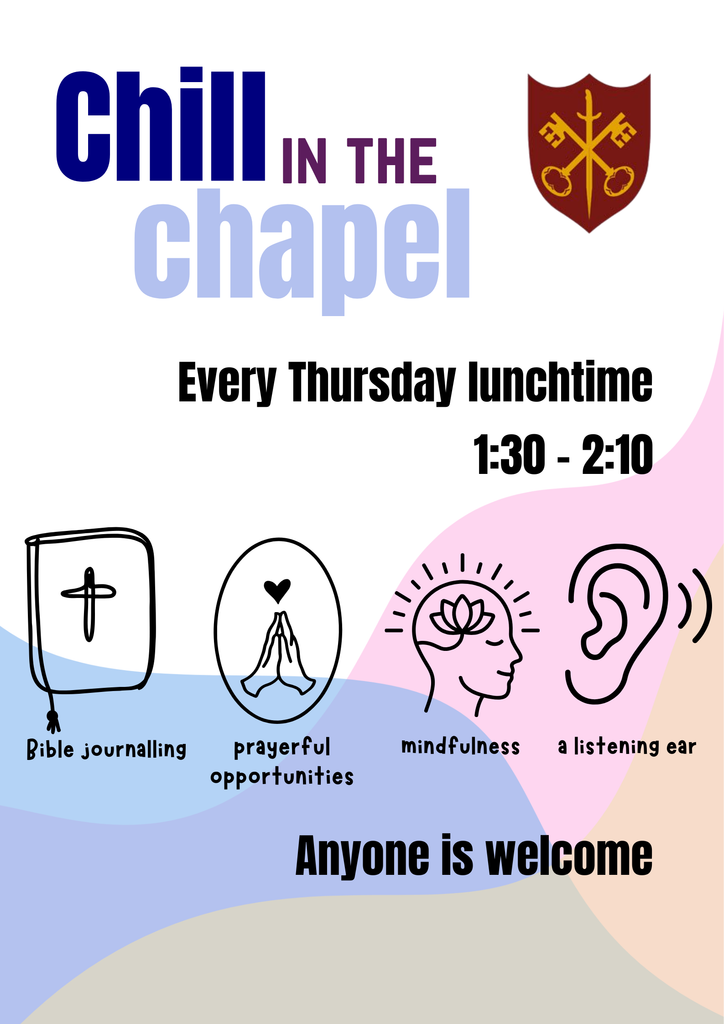
Would you like to be part of our student-led Chaplaincy Team?
Application forms now available!
Please come down to the community hub to collect one.
This year, we will have three student-led groups within one large Chaplaincy Team. If you’re interested in planning and/or leading prayer and liturgy, working towards justice and peace within the wider world, fundraising for good causes and engaging with the community, Lucy – our Lay Chaplain – would like to hear from you!
This is a new format this year, so even if you were in the Chaplaincy Team last year please do reapply and identify which part of the team you’d most like to get involved with. The aim is to start meetings in October.
For more information, drop into the Community Hub on a Monday, Thursday or Friday break time to chat with Lucy. Anyone is welcome. Application forms are now available. Just look to your left as you come into the building and you’ll see them in a red tray on the table just inside the door. Completed forms can be returned to Lucy during break on a Monday, Thursday or Friday or given to your form tutor FAO: Lucy.
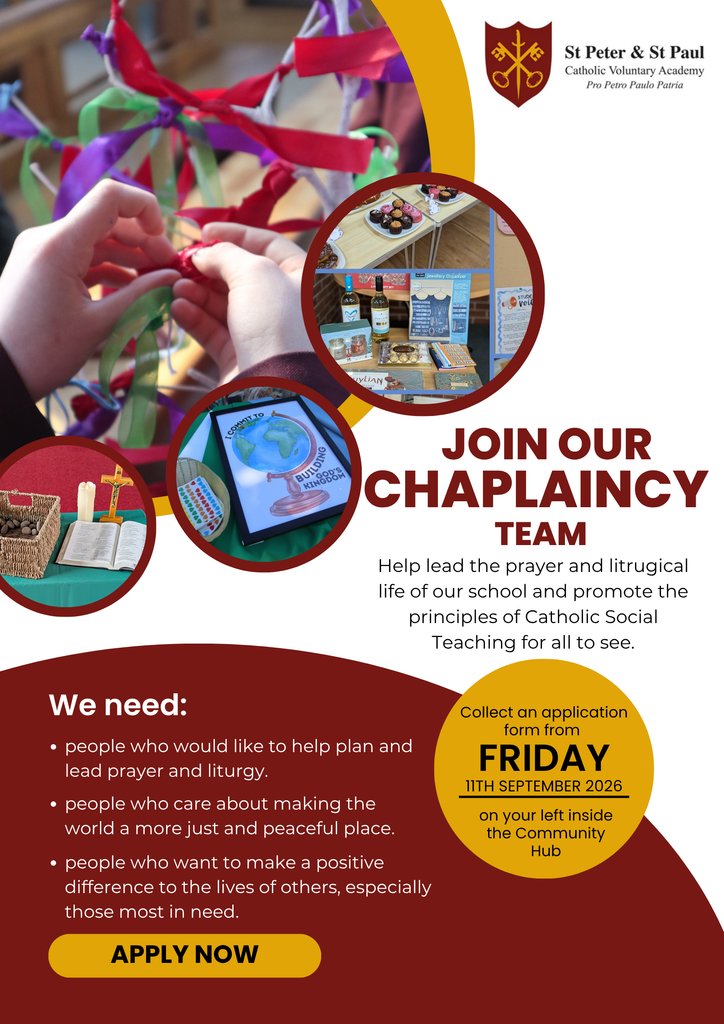
Are you looking for a quiet space to go at lunch time? Have you considered the chapel?
Our school chapel (at the bottom of the Humanities staircase) is a welcoming and inclusive space for everybody. You do not need to be Catholic to make use of the chapel. Although it is primarily a place of prayer and worship, it is also a suitable space for quiet reflection and wellbeing.
Lucy will be in the chapel every Thursday lunchtime offering some wellbeing and mindfulness activities. Anyone is welcome. You don’t need to stay for the whole of lunch either, just call in for as long as you’d like to and make sure you eat before or after you come. Thank you.
Here are some resources to help you with the planning of Celebrations of the word.
Open Bible – Search the Bible by keyword for scripture suitable to your theme.
Planning sheets – Use the planning sheets on this page to plan your Celebration of the word. Remember that somebody else should evaluate on the same sheet (or on a second copy) during or shortly after your delivery.
Seasonal music – Hymns and worship songs recorded by members of the Trust Chaplaincy Team suitable for different seasons and themes throughout the liturgical year.
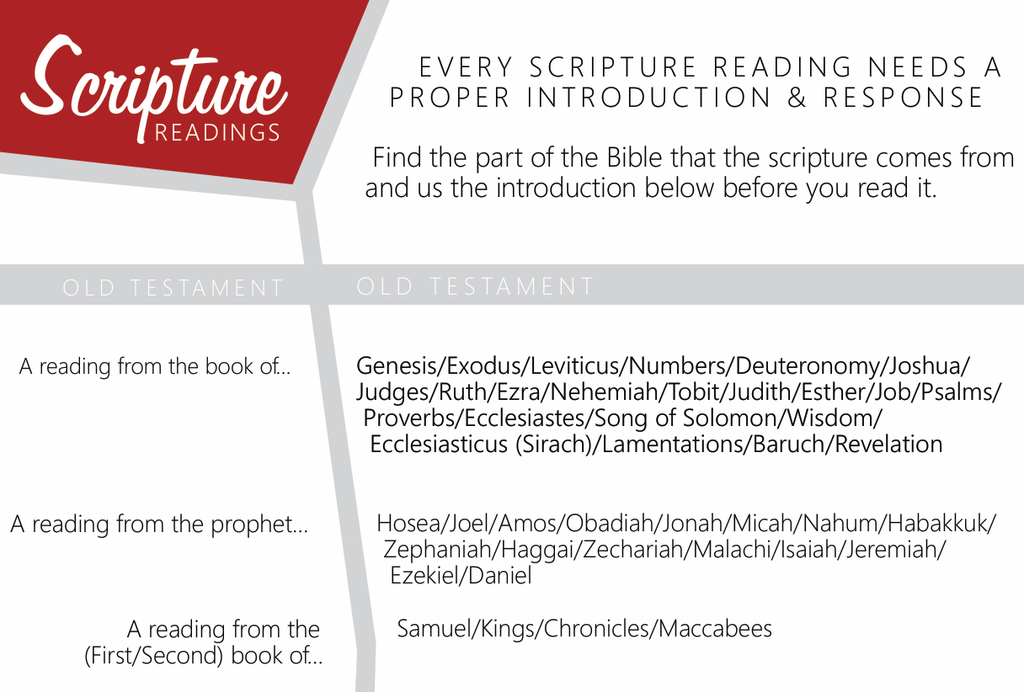
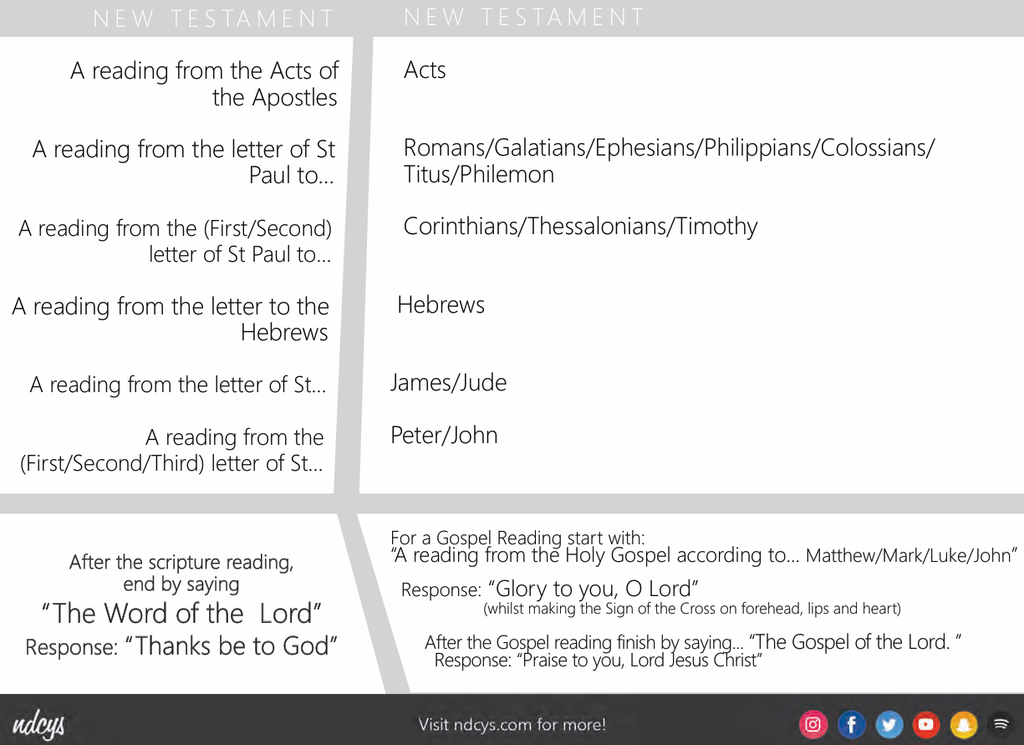
Introducing Scripture – It is very important that we give scripture the reverence it deserves. We should use translations taken from the English Standard Version at Saint Peter and Saint Paul’s. Ensure you choose this version if taking scripture from sites such as BibleGateway. Scripture should also be introduced and concluded correctly, depending on where in the Bible it comes from. A helpful guide can be found below. Please note the specific instructions and additions when scripture comes from one of the four Gospels (Matthew, Mark, Luke or John). Ordinarily, we stand for the Gospel and we stay seated for scripture which comes from elsewhere.



2 comments